 how-to
How to Stop Excessive Barking: Triggers and Solutions
Table of Contents
- Understanding Common Dog Barking Triggers
- Nuisance Barking Solutions That Work
- Frequently Asked Questions
Last Updated: September 13, 2026
Understanding Common Dog Barking Triggers
Excessive barking is repeated, hard-to-interrupt vocalization triggered by something specific, and this excessive barking rarely stops until that trigger is identified and managed. At Front Range K9 Academy, we've spent more than 36 years tracing barking to its source.
The Main Categories of Dog Barking Triggers
Most nuisance barking falls into recognizable patterns, and naming the pattern is the first step toward solving it.
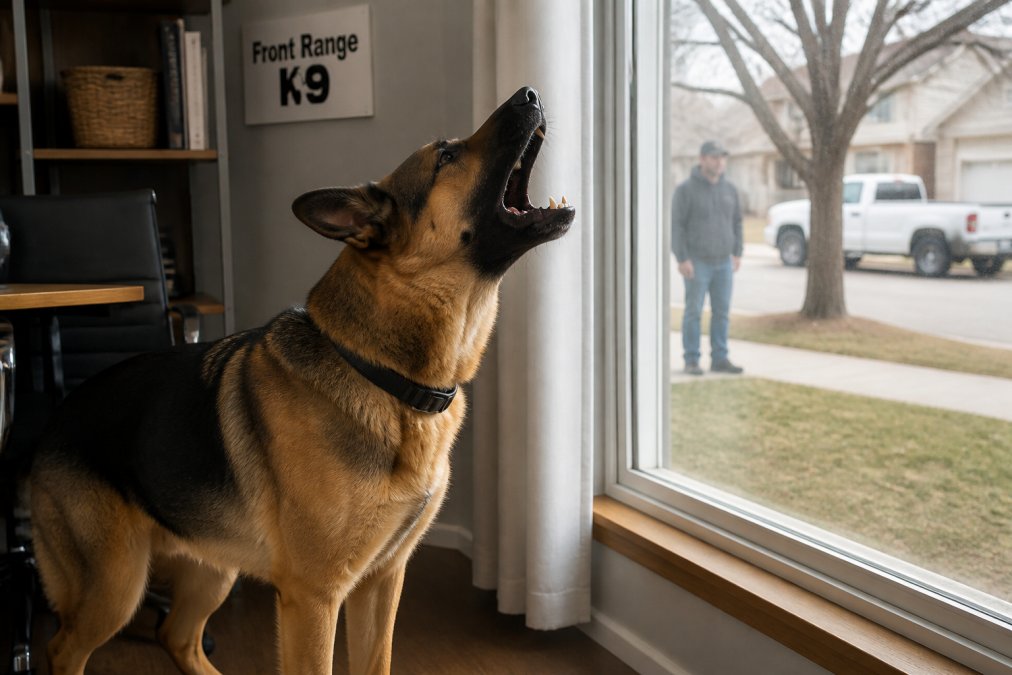
- Alert and territorial: barking at people, animals, or vehicles approaching the home
- Attention-seeking: barking directed at you, often with staring or nudging
- Boredom and frustration: repetitive barking from a dog with too little to do
- Separation-related distress: barking that starts shortly after you leave
- Compulsive: repetitive, self-reinforcing barking with no obvious trigger
Treating all five the same way is a common mistake, a territorial dog and a bored dog need different plans.

Why Breed Tendencies Matter
Genetics shape how much a dog vocalizes and what sets it off. Herding breeds often bark at movement, guardian breeds tend to be more territorial, and some hounds and toy breeds vocalize more freely.
Nuisance Barking Solutions That Work
Nuisance barking solutions work best when they combine management, structure, and professional behavioral modification rather than a single fix.
Start With Environmental Management
Environmental management means changing the dog's surroundings so the trigger is harder to reach, closing blinds, moving the crate, blocking sightlines to the fence. These changes don't teach anything on their own, but they lower stress enough that training can take hold.
Build a Consistent Daily Routine
Dogs thrive on predictability. A consistent routine with set times for exercise, feeding, outings, and rest reduces the arousal that fuels much nuisance barking.
Cover Physical Exercise and Mental Stimulation
A tired dog barks less, but tired means more than a quick lap around the block. Physical exercise and mental stimulation aren't interchangeable: sniffing walks do more for a reactive barker than a fast run, and enrichment toys give a bored dog a non-vocal outlet.
| Barking Pattern | What Usually Helps Most | What to Avoid |
|---|---|---|
| Alert / territorial | Environmental management, structured desensitization | Yelling at the window |
| Attention-seeking | Consistent routine, planned ignoring | Responding to demand barking |
| Boredom / frustration | Physical exercise, mental stimulation, enrichment toys | Longer alone time |
| Separation-related | Professional assessment, gradual routine changes | Punishment after the fact |
| Compulsive | Veterinary behaviorist referral | Home remedies alone |
Understand Desensitization and Counter-Conditioning
Desensitization means exposing a dog to a trigger at low intensity, then gradually increasing it; counter-conditioning pairs the trigger with something the dog values so the emotional response changes. Both take patience and precise timing, and both are far easier with a professional dog trainer guiding the process.
Know When to Bring In a Professional
Some barking is beyond what an owner should handle alone. Compulsive barking, separation anxiety, and barking tied to aggression all warrant a professional dog trainer or veterinary behaviorist, who can also assess whether an underlying medical issue is contributing. The same goes for other high-arousal reactions that show up outdoors, if your dog barks or lunges at snakes on the trail, snake avoidance dog training addresses that specific trigger.
At Front Range K9 Academy, we've worked with more than 10,000 dogs and owners, and the pattern is consistent: cases that stall at home tend to move once the trigger is correctly identified and the plan is built around it. Our private and group sessions are tailored to the individual dog, and we're a proud professional member of the International Association of Canine Professionals.
Tools and Gear: What's Worth Considering
Gear is a support tool, not a solution. The most useful items reduce a dog's exposure to triggers while training does the real work: window film, baby gates, white noise machines, and sturdy barriers.
On anti-bark devices, safety and legality vary by state and municipality. Check your local ordinances before buying anything, and talk to a qualified trainer or your veterinarian about whether a device is appropriate for your dog. No tool replaces addressing the reason the dog is barking.
Nighttime Barking: A Separate Problem
Nighttime barking deserves its own plan. A dog that sleeps all day and barks at 2 a.m. is often under-exercised, over-stimulated by evening activity, or reacting to sounds you can't hear. Adjust the evening routine, add a final sniffing walk, and provide a quiet, dark space away from street noise; if it continues, get professional eyes on the case.
Frequently Asked Questions
What are the common underlying causes of excessive barking in dogs?
Excessive barking usually traces back to a specific trigger, such as people walking past the house, other dogs, being left alone, or plain boredom. Territorial behavior, separation anxiety, and frustration all produce different barking patterns. Identifying which situation sets your dog off is the first step, because a solution aimed at the wrong cause rarely works.
What is the 3 bark rule for dogs?
The 3 bark rule is a common guideline owners use: allow a dog to bark two or three times to alert you, then step in to interrupt and redirect before it escalates. It gives a clear cutoff point so barking does not become a long, rehearsed habit. Consistency matters more than the exact number, and a professional trainer can help you apply it correctly.
How can professional dog behavior training help address nuisance barking?
A professional trainer observes your dog in real situations and pinpoints the trigger behind the noise. From there, a structured plan builds calm behavior around that trigger instead of just suppressing the sound. Front Range K9 Academy has more than 36 years of experience and has trained over 10,000 dogs and owners, so they can tailor the approach to your dog's age, breed, and history.
Barking that won't quit is exhausting, and it's rarely solved by trying harder with the same approach. Front Range K9 Academy has spent 36 years helping Northern Colorado owners get to the root of behaviors like barking, lunging, and jumping, with private and group sessions built around your dog and your goals. If you're ready for calmer days and quieter evenings, book your Temperament Test & Training Session and let our team build a plan that actually fits your dog.