 ultimate-guide
Why Professional Dog Temperament Testing Matters
Last Updated: October 24, 2026
Quick Summary
A dog temperament test is a structured assessment of how a dog responds to people, other dogs, handling, and unfamiliar situations. It replaces labels with a behavioral profile showing what triggers the dog, how quickly it recovers, and what it needs from training. Professional assessment reads the dog in front of you rather than promising a forecast.
- A professional dog temperament test typically runs 30 to 90 minutes depending on the scenarios observed.
- Each core question maps to a trait you will live with at home, such as sociability or sound sensitivity.
- A rushed test under stressful conditions produces inaccurate results, so a good assessor builds in rest.
- The output is a written profile of behavioral traits, triggers, training needs, and household suitability.
- Front Range K9 Academy has spent more than 36 years evaluating dogs before training begins.
Table of Contents
- Why a Professional Dog Temperament Test Beats a Guess
- Dog Temperament Test Questions and What Each One Reveals
- Dog Temperament Test Duration: What the Time Actually Buys You
- Frequently Asked Questions
Why a Professional Dog Temperament Test Beats a Guess
A dog temperament test is a structured assessment of how a dog responds to people, other dogs, handling, and unfamiliar situations. Research summarized by the American Kennel Club on puppy temperament testing found that current puppy temperament tests do not reliably predict adult behavior, which is exactly why a professional assessment matters: it reads the dog in front of you rather than promising a forecast. At Front Range K9 Academy, we have spent more than 36 years watching how much difference a careful, structured evaluation makes before training begins.
A professional dog temperament test replaces labels with a behavioral profile: what triggers the dog, how quickly it recovers, and what it needs from training. If reactivity is part of the picture, our Aggression Control work picks up where the assessment leaves off, and owners can read how a behaviorist differs from a trainer before booking.
Dog Temperament Test Questions and What Each One Reveals
A professional dog temperament test asks a fixed set of questions, each mapping to a trait you will live with at home.
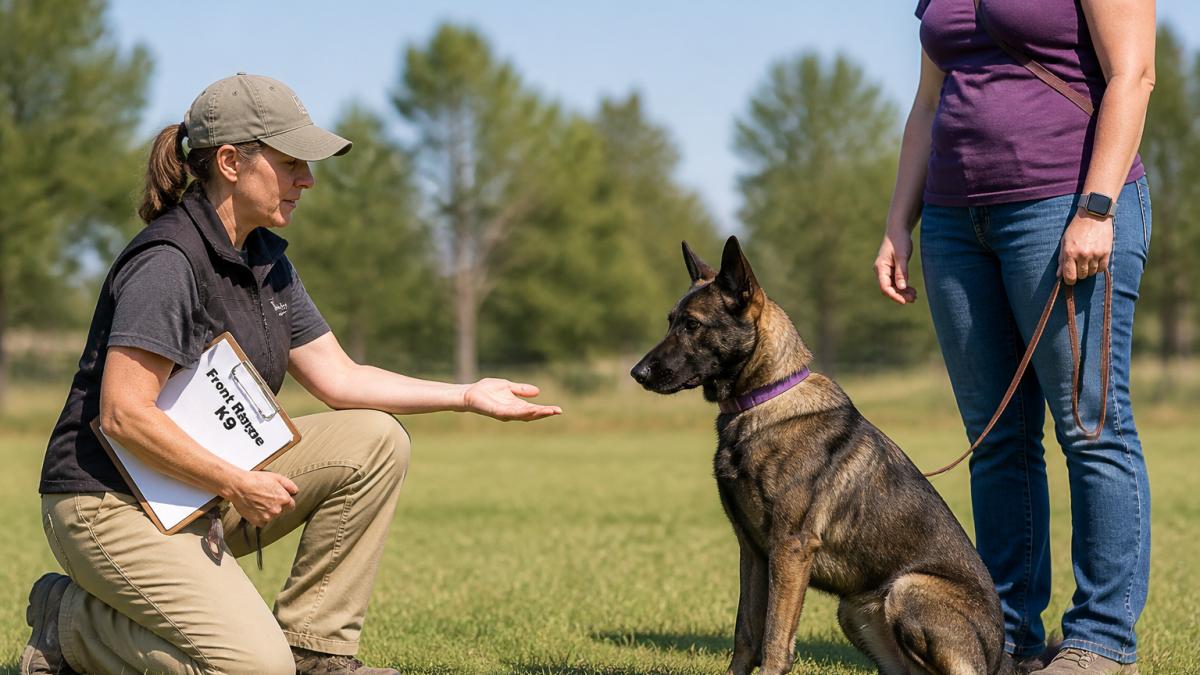
The core questions:
- How does the dog greet an unfamiliar person? Reveals sociability and whether fear or protective instinct drives the first reaction.
- How does the dog handle being touched and handled? Reveals tolerance for vet visits, grooming, and family handling.
- What happens around novel objects and sounds? Reveals startle response, sound sensitivity, and recovery speed.
- How does the dog behave around other dogs? Reveals play style, sociability, and reactivity risk.
- How does the dog respond to an unfamiliar situation? Reveals confidence, stability, and arousal under mild stress.
Every answer is a snapshot in time, not a lifelong verdict. If a question uncovers reactivity or aggression, our guide to aggressive dog training covers the behavior-change path, and canine behavior modification techniques explains the methods.
Each core question in a professional temperament test maps to a trait you will live with at home.
Book your Temperament Test & Training Session →
| Question | What it reveals |
|---|---|
| How does the dog greet an unfamiliar person? | Sociability; whether fear or protective instinct drives first reaction |
| How does the dog handle being touched and handled? | Tolerance for vet visits, grooming, and family handling |
| What happens around novel objects and sounds? | Startle response, sound sensitivity, and recovery speed |
| How does the dog behave around other dogs? | Play style, sociability, and reactivity risk |
| How does the dog respond to an unfamiliar situation? | Confidence, stability, and arousal under mild stress |
Dog Temperament Test Duration: What the Time Actually Buys You
A professional dog temperament test typically runs 30 to 90 minutes, reflecting how many scenarios the assessor needs to observe. A puppy or confident adult may move through quickly; a dog with a bite history or heavy fear needs slower introductions and more recovery time.
What the time buys you is welfare-first observation: a rushed test under stressful conditions produces inaccurate results, so a good assessor builds in rest and never forces an interaction. The output is a written profile of behavioral traits, triggers, training needs, and household suitability.
Once you have that profile, the next step is a conversation. Contact our Northern Colorado trainers to book a temperament test and training session, and bring your questions about protocol and next steps. If your dog will spend time on trails or open land, ask about our snake avoidance dog training as well, it is a practical complement to knowing your dog's temperament and triggers outdoors.
Frequently Asked Questions
What is a professional dog temperament test?
It is a structured behavior assessment run by a trained evaluator who observes how a dog responds to strangers, other dogs, handling, novel objects, and sudden sounds. The goal is to map behavioral traits such as confidence, sociability, reactivity, and recovery after a startle. The American Kennel Club notes that tests measure reactions to elements including strangers, while shelter-focused assessments look at responses to other dogs and suitability for adoption. A professional reads those reactions against a consistent protocol rather than a single snapshot.
Can a dog temperament test predict how a dog will behave in the future?
Not with certainty. Research summarized by the American Kennel Club found that current puppy temperament tests do not predict adult behavior, and a temperament test is best treated as a snapshot in time rather than a lifelong state. The ASPCA has also stated that behavior assessments have not proven highly accurate for predicting aggression after adoption. What the results do give you is a clearer picture of your dog's natural predisposition and behavioral response patterns today, which is exactly what a training plan needs to work from.
How long does a dog temperament assessment take, and what should I ask beforehand?
Duration varies with the protocol and the dog's age, so ask the tester directly rather than assuming. Good dog temperament test questions include which traits are scored, how stress and arousal are managed during the session, whether the evaluator holds a professional credential, and how results translate into a training plan. Ask whether you will receive a written summary and whether reassessment is offered later. Front Range K9 Academy has 36+ years of experience and is a professional member of the International Association of Canine Professionals.
Your dog's behavior is not a mystery to be guessed at from the end of a leash. It is a set of traits that can be observed, documented, and worked with. Front Range K9 Academy has trained more than 10,000 dogs and owners across Northern Colorado, and our private sessions and small group classes are built around individual assessments rather than one-size-fits-all plans. Get started with Front Range K9 Academy and trade the guesswork for a clear, professional read on your dog.